Cashier
USDC Casino Cashier: What the Dollar Peg Changes for Your Balance and Your Bonus
A USDC balance is counted in a unit that is meant to equal one US dollar. That single design choice is what this site is about: it changes what a stake means, how a bonus is measured, and the places where a cashier quietly turns one thing into another.
Twelve operators are covered, each on a page of its own, and none is put above another. What each one says about USDC comes from its own help pages or its own cashier code. Where we could not read an operator, the page says so rather than guessing.
Is USDC always worth one dollar?
No coin is worth one dollar by decree. USDC is designed to be: its issuer, Circle, says each token can be redeemed one for one for US dollars by customers who hold an account with it, and the reserves behind the token are what back that promise. On an exchange or a casino cashier, though, nobody redeems anything. The price you see is whatever the market agrees to, and the market usually agrees on a dollar.
Usually is the word to keep in mind. In March 2023 USDC dipped under ninety cents over a weekend after a bank that held part of its reserves failed, and it was back near a dollar within days. Nothing about that episode makes the coin unfit for a cashier, but it separates two risks that a volatile coin blurs together. A coin like Bitcoin carries price risk all the time. A stablecoin carries peg risk rarely, and when it happens it is a gap, not a drift.
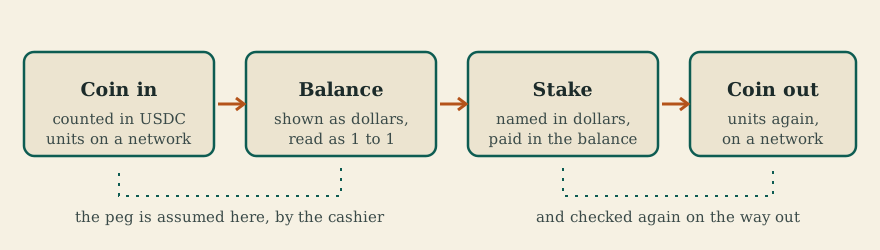
A casino cashier does not measure the gap. It assumes the peg and counts one unit as one dollar. This site keeps asking where that assumption sits: in the balance, in the stake, in a minimum, in a payout limit.
What a stablecoin does to a casino balance
Deposit 0.01 of a volatile coin, play for a week and cash out, and the number you end up with mixes two stories: what the games did and what the market did. You cannot read your own results without separating them. With a coin held at a dollar, the second story is mostly absent, so a balance that went from one hundred to ninety is a ten-unit result, and nothing else.
The same steadiness is what lets a stake be named in dollars. When a cashier shows a bet size as a dollar figure, it is leaning on the peg: the bet is the same sum at the moment you place it and at the moment you check your history. Cloudbet's own currency configuration, which we read in the source of its fee page, tags USDC as pegged to USD and defines a dollar display with a factor of one. That is a design decision written in code, and it is precisely the assumption described above.
Bonus arithmetic on a stable base
Wagering terms multiply a base. The base might be the deposit, the bonus, or the two added together, and the multiple says how much has to be staked before the bonus money can leave. Nothing on this site gives you an operator's multiple, because none of the twelve published one on a page we could read. What can be said in general is what a stable unit does to the sum.
On a volatile coin, the base can be fixed in coin units or converted into dollars at the moment of the claim, and the two readings drift apart as the price moves. On USDC the two readings stay within a hair of each other, so the question of which one the terms use matters much less. Whatever you owe in turnover stays the size it was when you accepted. The bonuses page walks through the mechanics with made-up round numbers that are flagged as not belonging to any operator.
Which network carries USDC, and what the terms permit
One coin travels on several roads, and each road has its own address format and its own cashier rules. Cloudbet lists seven for USDC: Ethereum, BNB Smart Chain, Avalanche C-Chain, Solana, Polygon (native USDC), TRON and Base. Stake names four in a help article stamped late August 2026: ERC20, BSC (BEP20), Polygon and Solana. Duelbits shows two in a picture inside a January 2026 article, Ethereum [ERC-20] and Solana. Rollbit speaks of ERC-20 tokens. Roobet, Sportsbet.io and BetFury name the coin and leave the road unnamed.
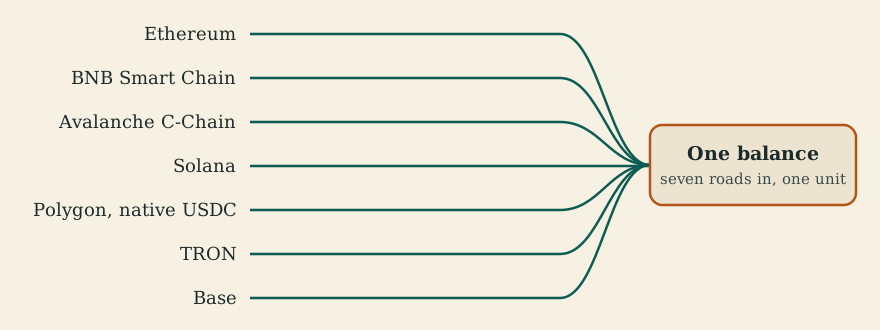
The practical point is that the peg travels with the coin and the road does not. A dollar sent down a road the cashier does not read is not a dollar at the cashier; it is a recovery problem. The payments page sets the roads and the printed minimums side by side, with the source of each.
Twelve cashiers, one at a time
Each card opens a note about one operator. They are in alphabetical order, which carries no meaning. The Visit link on a card leaves for the operator's own site after an age question.

BC.GAME
USDC is not on the one line we could read.

BetFury
USDC is listed; the network is left to you.

BitStarz
Floor in USDC, payout limits in euros.

Cloudbet
Seven networks and a dollar-pegged config.

CoinCasino
A cashier we could not tie to this brand.

Duelbits
Two networks, shown in a picture.

FortuneJack
Closed to us, so nothing is claimed.

Rollbit
Stablecoin floors written in dollars.

Roobet
USDC named, deposit needs three confirmations.

Sportsbet.io
A quarter of a coin as the entry floor.

Stake
Four networks, and a floor in cents.

Vave
A short list with an old stamp.
What is left out on purpose
There is no welcome offer, wagering multiple, licence detail or rating for any operator on this site. None of them was read from an operator's own page, and a number remembered from a comparison site is worse than a blank space. Terms live in the cashier and in the operator's rules, which is where they get changed.
Fees in the coin's own units are also left out. They move between one reading of a page and the next, so the site gives only the minimums an operator prints, says where each one sits, and points back to the cashier.
Questions about USDC at a casino
Is USDC always one dollar?
It is designed to be and it almost always trades there, but the one-to-one rate is a target backed by reserves and by redemption with the issuer. For a few days in March 2023 it traded under ninety cents. A casino cashier assumes the peg instead of testing it.
Can I convert my USDC to cash?
Not at the casino, as a rule. A cashier pays out in the same unit it took, to an address you give it. Turning that unit into money in a bank account is a separate step, normally done on an exchange that handles USDC, and that step has its own price and its own fees.
How can I withdraw USDC from a casino?
Pick the network your receiving wallet or exchange uses, paste the address that belongs to that network, and enter the amount. The operator checks the request first; when it releases the payment, the network carries it. These are two separate waits, and the withdrawal records note says what to keep from each.
What does it mean to deposit USDC?
You send USDC from a wallet or exchange to a deposit address the cashier gives you, on a network the cashier supports. The cashier credits your balance after the network has confirmed the transfer. The amount shown is read as dollars.